



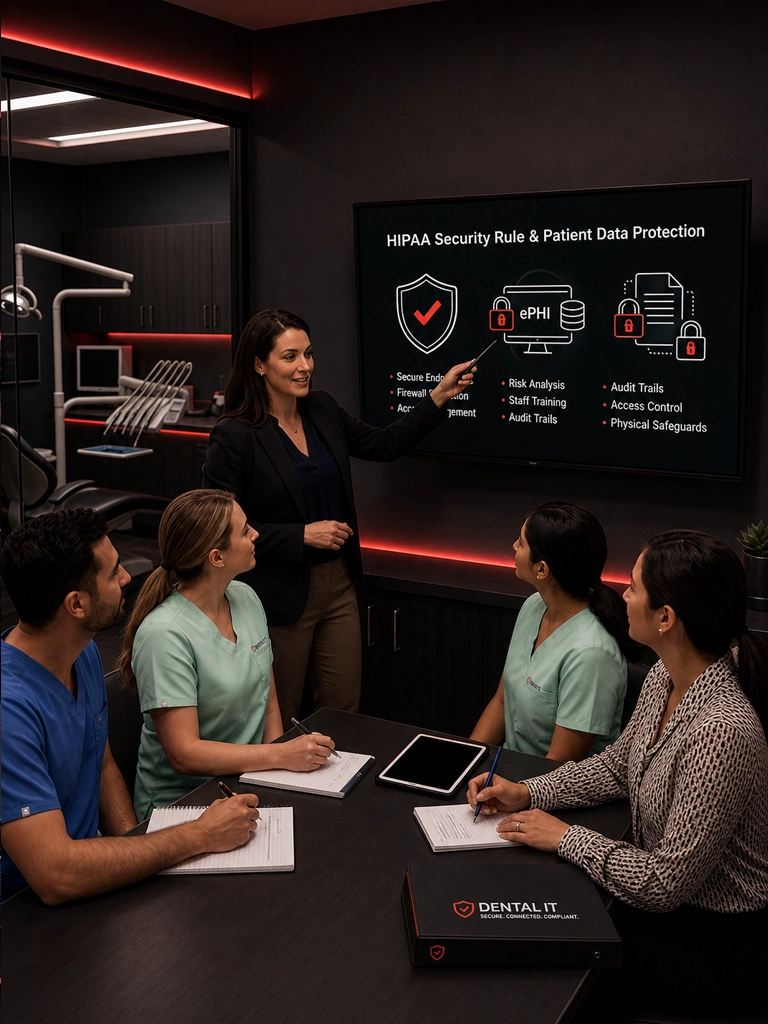
Risk Assessments & Gap Analysis
Evaluate your current IT environment, workflows, devices, access controls, and documentation to identify vulnerabilities and compliance gaps.
Dental IT helps dental practices protect patient information, prepare documentation, identify compliance gaps, strengthen security controls, train staff, and maintain a HIPAA-conscious IT environment.
HIPAA risk assessments and gap analysis
Policy, procedure, and documentation support
Staff training and security awareness guidance
Audit preparation, reporting, and remediation planning
HIPAA support for dental offices
Dental IT helps dental practices review risks, organize documentation, improve safeguards, train staff, and connect HIPAA-conscious planning to the systems that store or access patient information.
HIPAA risk assessment and gap analysis for dental technology environments
Policy, procedure, training, and documentation support
Administrative, physical, and technical safeguard planning
Security controls, audit preparation, reporting, and remediation guidance
Serving dental practices in Miami, South Florida, and surrounding Florida markets.
Schedule HIPAA ConsultationComprehensive HIPAA Compliance Services
HIPAA consulting helps your dental practice identify risks, document policies, strengthen technical controls, educate staff, and maintain a more secure environment for electronic patient data.
HIPAA risk assessment and gap analysis
Policy, procedure, training, and documentation support
Security controls, audit preparation, and ongoing reporting
Audit Readiness
Dental IT helps translate HIPAA expectations into practical steps your team can understand, document, and maintain across daily dental operations.
HIPAA
privacy and security support for dental practices
ePHI
protection planning for electronic patient data
24/7
security-conscious monitoring and reporting options
What Our HIPAA Compliance Services Include
From risk assessments and documentation to employee training and audit preparation, Dental IT helps your practice build a stronger compliance foundation.
Evaluate your current IT environment, workflows, devices, access controls, and documentation to identify vulnerabilities and compliance gaps.
Create and document HIPAA-aligned policies for access controls, security responsibilities, incident response, backup expectations, and staff workflows.
Plan and deploy safeguards such as encryption strategy, multi-factor authentication, audit logging, access control, and endpoint protection.
Educate your team on privacy expectations, breach prevention, phishing awareness, reporting steps, and safer handling of patient information.
Prepare for HIPAA reviews with mock audits, documentation review, evidence organization, corrective action planning, and practical remediation guidance.
Use compliance dashboards, reports, documentation reviews, and security monitoring to track progress and support audit readiness over time.
Taking Care of Compliance
Compliance requires more than a checklist. Your dental practice needs practical guidance that connects policies, people, devices, software, security controls, and documentation.
We understand the systems dental offices use every day, including practice management software, imaging platforms, workstations, servers, backups, and cloud tools.
HIPAA consulting should not stop at paperwork. We help connect your documentation to practical safeguards and technology workflows.
Compliance support is strongest when paired with cybersecurity, backup planning, access control, monitoring, and endpoint protection.
HIPAA is not a one-time task. We help practices review, improve, and maintain safeguards as the office, team, and technology change.
HIPAA Safeguards
HIPAA Security Rule planning should help protect electronic protected health information with safeguards that make sense for your practice size, workflow, systems, and risk profile.
Policies, training, access planning, security responsibilities, documentation, risk review, and workforce procedures.
Workstation use, device handling, facility access, equipment placement, and protection for systems that store or access ePHI.
Access controls, audit logs, encryption planning, authentication, backups, endpoint security, and secure system configuration.
Organized records, remediation tracking, compliance reports, audit preparation, and evidence that supports security decisions.
Why Does Your Dental Practice Need HIPAA Compliance?
HIPAA compliance helps your practice avoid unnecessary risk, protect patient information, prepare for audits, reduce breach exposure, and maintain operational continuity.
Non-compliance can expose practices to investigations, penalties, corrective action plans, and legal risk.
Strong privacy and security safeguards help patients feel confident that their information is handled responsibly.
Risk assessments, staff awareness, access controls, backups, and monitoring help reduce the chance of patient data exposure.
Well-organized documentation and regular reporting make compliance reviews easier to manage.
A compliance-conscious practice is better prepared to respond to incidents, recover quickly, and keep patient care moving.
HIPAA-Conscious IT Planning
The HIPAA Security Rule requires appropriate administrative, physical, and technical safeguards to help protect electronic protected health information. Dental IT helps your practice connect those safeguards to real-world systems, users, devices, backups, and documentation.
Compliance Framework
HIPAA consulting should help your dental office identify gaps, document policies, train staff, strengthen security controls, prepare for audits, and keep compliance work moving over time.
Administrative safeguards for policies, workforce training, risk analysis, access planning, and documentation.
Physical safeguards for workstations, devices, office access, and systems that store or access electronic protected health information.
Technical safeguards for access control, audit logging, encryption planning, authentication, backup strategy, and secure system configuration.
Corrective action planning to help close gaps discovered during HIPAA risk assessments and documentation reviews.
Ready to strengthen HIPAA compliance?