


Security Experts
Leverage advanced threat intelligence and practical cybersecurity expertise designed to protect the devices your dental team depends on.
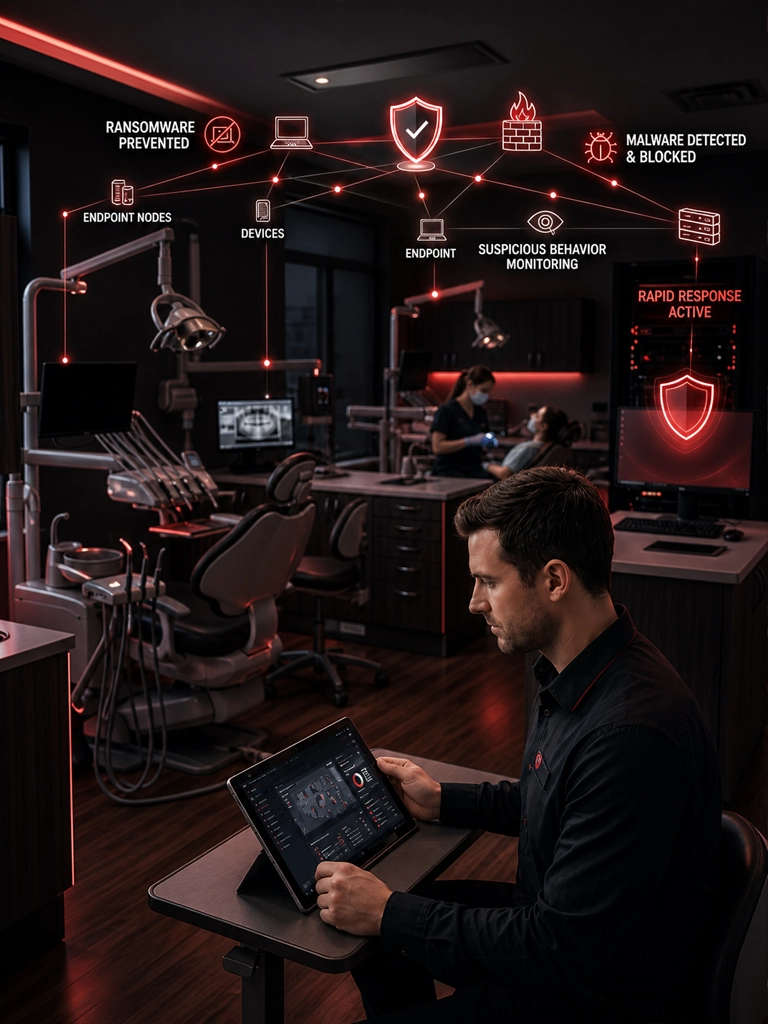
Dental IT helps protect every device in your practice with real-time monitoring, intelligent threat hunting, ransomware defense, rapid response, and security reporting designed around dental workflows.
Real-time monitoring across practice devices
Threat hunting for ransomware, malware, and suspicious behavior
Rapid response to contain endpoint security incidents
HIPAA-conscious logging, reporting, and patient data protection
Proactive Threat Detection
Endpoint Detection & Response protects the workstations, laptops, servers, and clinical devices that connect your team to scheduling, imaging, billing, treatment planning, and patient data.
Endpoint Detection & Response for dental workstations
Ransomware, malware, zero-day, and suspicious behavior monitoring
Security reporting and HIPAA-conscious endpoint documentation
Peace of Mind
EDR helps your practice move from passive protection to active visibility. Instead of waiting for a major incident, endpoints can be monitored for suspicious behavior and contained faster.
24/7
endpoint monitoring and alert visibility
EDR
advanced detection and response for workstations
HIPAA
security-conscious reporting and audit support
Our Endpoint Detection & Response Expertise
Endpoint security should protect more than computers. It should protect the continuity of your appointments, imaging workflows, billing systems, team productivity, and patient trust.
Leverage advanced threat intelligence and practical cybersecurity expertise designed to protect the devices your dental team depends on.
Our security-focused approach helps monitor alerts, evaluate suspicious activity, and respond quickly when endpoints show signs of compromise.
Endpoint Detection & Response can support logging, audit trails, secure handling, and documentation around devices that access patient information.
Protect one dental office, multiple locations, front desk workstations, imaging stations, laptops, servers, and clinical devices as your practice grows.
Monitor workstations, laptops, servers, and practice devices for unusual activity, suspicious processes, and possible signs of compromise.
Look beyond traditional antivirus by identifying behavior patterns that may indicate ransomware, zero-day attacks, malware, or unauthorized access.
When an endpoint shows suspicious activity, response workflows can help isolate, contain, and reduce the impact of the threat.
Strengthen your practice against ransomware attempts that could encrypt files, disrupt operations, or threaten access to critical systems.
Use reporting and endpoint visibility to support better security decisions, technology reviews, and compliance-conscious documentation.
Protect the endpoints your team uses every day, including front desk computers, treatment room stations, imaging workstations, and laptops.
Taking Care of Your Practice
Endpoint security needs continuous visibility, fast response, practical reporting, and a dental-focused understanding of the devices your practice uses every day.
We understand how dental teams rely on workstations, imaging systems, scheduling tools, billing systems, servers, and patient data access.
EDR helps reduce the time between suspicious activity, alert review, containment, and remediation.
Modern threats often require behavior-based detection, monitoring, response, and endpoint visibility beyond basic antivirus tools.
Endpoint security can scale with additional providers, operatories, locations, workstations, and cloud-connected workflows.
Endpoint Coverage
Endpoint Detection & Response works best when the devices across your dental environment are visible, monitored, documented, and protected with a clear security plan.
Protect scheduling, billing, communication, insurance, and administrative devices that keep daily operations moving.
Support endpoint security for chairside systems used during treatment planning, charting, imaging access, and patient care.
Monitor critical systems that support software access, file sharing, backups, and centralized practice workflows.
Extend endpoint visibility to laptops, satellite offices, remote workflows, and growing multi-location dental teams.
Why Does Your Dental Practice Need Endpoint Security?
Ransomware, malware, zero-day attacks, unauthorized access, and compromised devices can threaten patient data and interrupt the systems your team depends on.
Stop sophisticated attacks before they encrypt files, lock systems, or interrupt your dental practice operations.
Automated alerts and response workflows help reduce the window of vulnerability when suspicious activity appears.
Endpoint security helps reduce the risk of data breaches that can damage reputation, trust, and patient confidence.
Logging, reporting, and visibility can support HIPAA-conscious reviews and security documentation.
Rapid containment helps keep scheduling, imaging, billing, and daily clinical systems available when threats appear.
HIPAA-Conscious Endpoint Security
Dental workstations, laptops, servers, imaging devices, and clinical systems often access electronic protected health information. Endpoint Detection & Response helps strengthen visibility and response around the devices that touch patient data.
Endpoint Governance
Endpoint security should help your practice understand what is happening across devices, respond to suspicious activity, support internal reviews, and maintain stronger security documentation.
Endpoint monitoring for devices that access electronic protected health information.
Security logs and reporting to support HIPAA-conscious documentation and review.
Response planning for malware, ransomware, suspicious behavior, and unauthorized access attempts.
Endpoint visibility across workstations, laptops, servers, imaging stations, and multi-location environments.
Frequently Asked Questions
Helpful answers about how this service works for dental offices, IT environments, dental software, security, and HIPAA-conscious workflows.
Endpoint Detection and Response, or EDR, can include real-time monitoring, suspicious behavior detection, ransomware defense, malware visibility, threat hunting, endpoint isolation, incident response workflows, security reporting, and protection for workstations, laptops, servers, imaging stations, and other devices used by the dental team.
Basic antivirus usually focuses on blocking known threats. EDR goes further by monitoring endpoint behavior, identifying suspicious activity, supporting threat investigation, and helping contain incidents quickly. For dental practices, this added visibility can help reduce the risk of ransomware, data exposure, and operational downtime.
Yes, EDR can work in dental environments when it is deployed carefully. Dental IT considers practice management software, imaging systems, servers, front desk workstations, clinical devices, and vendor requirements so endpoint protection supports security without unnecessarily disrupting patient care workflows.
Deployment time depends on the number of devices, locations, workstation condition, existing security tools, software compatibility, and any cleanup needed before rollout. A smaller office may move quickly, while larger or multi-location practices may need a phased deployment and monitoring plan.
EDR can support HIPAA-conscious security by improving visibility into devices that access electronic patient information. It can help with endpoint monitoring, security reporting, suspicious activity detection, incident response planning, and documentation. HIPAA compliance is broader than EDR alone, but endpoint protection is an important technical safeguard.
Dental IT supports endpoint detection and response planning for dental practices across South Florida.
Broward Dental IT Services
~45 min onsite from West Kendall
Palm Beach Dental IT Services
~75 min onsite from West Kendall
Ready for stronger endpoint security?